How do you support veterans during an ongoing war? How can military personnel and their families adapt to a reality that keeps changing? What can the Netherlands learn from a society in which war has become part of everyday life?
These questions took centre stage at Researchers Day 2026, organised by the Dutch Veteran Healthcare System (LZV) and the Dutch Veterans Institute (NLVi). Under the theme Lessons in Resilience: A Ukrainian Perspective, researchers and policymakers came together to explore what Ukraine's experiences can teach us about resilience.
Opening the day, Pieter Hakvoort, Chair of the LZV, warmly welcomed the participants and speakers, particularly the Ukrainian guests. His central message was that peace and freedom cannot be taken for granted. Ukraine reminds us not only of the devastating human cost of war, but also of the extraordinary resilience people demonstrate in the face of adversity. He challenged participants to reflect on how prepared and resilient Dutch society truly is, emphasising how much we can learn from those experiencing war firsthand.
From bouncing back to bouncing forward
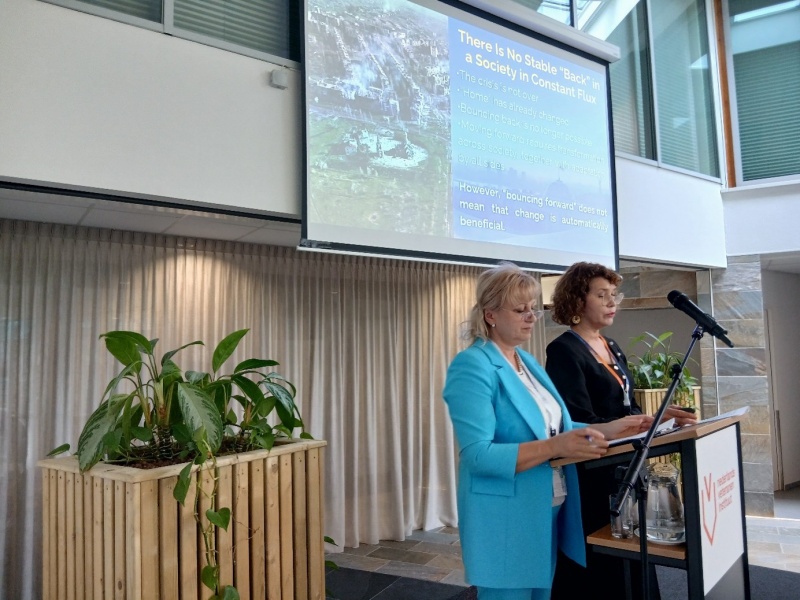
In their keynote, Beyond One-Way Reintegration: Ukraine's Parliamentary and Institutional Approach to Veterans Policy, Dr Anna Nechai, Professor of Academic Yurij Bugaj International Scientific-Technical University (Kyiv, Ukraine), a researcher at KU Leuven in Belgium, mediator and trainer, and Dr Lesia Vaolevska, Head of the Research Service of the Verkhovna Rada of Ukraine, discussed the challenges of supporting veterans and the wider society during war and its continuously changing reality. Drawing on psychological research, practical experience and the work of Ukraine’s parliamentary institutions, the speakers explored why veteran reintegration requires not only individual support but also institutional adaptation.
One of the strongest messages was the need to reconsider what we mean by resilience and reintegration. Resilience is often described as the ability to bounce back after adversity: to recover and return to how things were before. But what if returning to the previous situation is neither possible nor desirable? Ukrainian society has been profoundly transformed by war. For veterans returning from the front, there may be no previous situation to return to. Their society, communities, relationships and social roles may have changed. Society itself may never be quite the same again. In this context, Dr Nechai posits that resilience is better understood as the capacity to bounce forward: to adapt to changing circumstances, find new ways of living and preserve what matters most.
Reintegration while the war continues
These changes have profound implications for veteran reintegration. It is not simply a matter of helping military personnel return to civilian life after deployment. The war continues, bringing ongoing danger, loss and uncertainty. Service personnel may return home temporarily, knowing they will soon be back at the front. Meanwhile, the families and communities they return to have also changed. Reintegration therefore cannot be viewed as the responsibility of veterans alone. It is a collective process in which families, employers, communities, institutions and society at large all have a role to play. Moreover, veteran support is becoming a matter of national policy, extending to include physical rehabilitation, psychosocial care and support, supporting veteran employment opportunities and veteran families.
As the speakers emphasised, supporting veterans is not merely a response to the consequences of war; it is an investment in people and in society’s future. They propose that veteran reintegration in a society in constant flux should be understood as an ongoing process of mutual adaptation and, where necessary, shared transformation, through which veterans, families, workplaces, communities and public institutions renegotiate roles, relationships and expectations, and reshape practices that no longer meet their changing needs. Rather than seeking to restore pre-war arrangements, this process aims to enable meaningful participation in civilian life while preserving human dignity, rights and agency. Responsibility for change is shared but not equal, reflecting differences in the authority, resources and obligations of the actors involved.
The scale of the challenge is considerable: by May 2026, Ukraine had approximately two million veterans, including around 1.47 million combatants. This raises a fundamental question: how can Ukraine develop and implement effective reintegration policies on such a large scale when the society to which veterans return is itself constantly changing and adapting to the realities of war?
The Research Service of the Verkhovna Rada of Ukraine contributes to this task through evidence-based support for parliamentary decision-making. Its specialists examine international experience and foreign legislation, analyse the implementation of Ukrainian laws, provide expert assistance with draft legislation and contribute to working groups on veteran policy. Its analytical work also addresses veterans’ access to education, employment and entrepreneurship, helping connect legislative approaches with the practical needs of those returning to civilian life.
The parliamentary response is also taking practical shape. In September 2026, the Secretariat of the Verkhovna Rada of Ukraine launched its first three-month internship programme for war veterans to gain first-hand experience of parliamentary work and explore opportunities to apply their skills in public service. The Research Service is contributing to the programme through a series of specialised lectures covering the constitutional foundations of Parliament, the legislative process, interparliamentary cooperation, European integration, national security, veteran policy, public administration and public service. This is a concrete example of two-way reintegration: veterans acquire knowledge of civilian institutions, while parliamentary institutions create opportunities to recognise and benefit from their experience.
When different survival strategies collide
Another thought-provoking insight concerned the relationship between veterans and civilians. Military personnel and civilians may develop different ways of coping with the same war. For soldiers, survival may depend on remaining alert, acting decisively and postponing emotional responses. For civilians, it may involve preserving as much normality as possible: continuing to work, maintaining everyday routines and taking opportunities for relaxation despite continuous threats and uncertainty. Both strategies are understandable and potentially adaptive responses to extraordinary circumstances. Yet when soldiers return home, these different coping strategies can lead to misunderstanding. A veteran may interpret civilians’ efforts to continue normal life as indifference to the sacrifices made at the front. Conversely, civilians may perceive a veteran's heightened alertness, directness or emotional responses as threatening or aggressive.
Recognising these differences is essential to preventing avoidable conflict and preparing not only veterans, but also employers, communities and public institutions, for reintegration.
The Research Service’s wider professional training activities offer an additional means of building this capacity. Between 2022 and August 2026, it developed 88 advanced training programmes and organised 147 training events for 14,220 participants, including parliamentarians, Secretariat staff and parliamentary assistants. Among these activities was Stress as a Part of Modern Life and Ways to Improve Physical and Mental Well-Being, a programme developed by Dr Nechai and delivered through the Research Service to more than 200 participants in 2025–2026. Although this programme was not exclusively designed for veterans, it illustrates how training in stress management and well-being can strengthen the professional environment in which veterans and civilians interact.
Importance of working together
Dr Nechai and Dr Vaolevska invited Dutch researchers and institutions to
collaborate with their Ukrainian counterparts as equal partners. Researchers
from countries not directly affected by war have much to learn from Ukraine's
lived experiences of conflict, adversity and resilience. At the same time,
Ukraine needs support to strengthen its academic research and training capacity during an ongoing crisis.
Such partnerships offer opportunities for mutual learning, knowledge exchange
and research that is both scientifically meaningful and grounded in the
realities of war.